The 5 Essential Supplements I take every day — and why
As a pharmacist, everyone assumes I take an endless list of supplements. The truth is, I don’t. There are only five—chosen with the same scientific rigor I would use when advising any patient. Over more than 20 years in the healthcare field, I’ve realized that evidence-based simplicity always beats marketing-driven complexity. These five supplements are my daily commitment to prevention and well-being. I’ll explain what they are, how they work in your body, and—just as important—how to choose a product that’s truly worth your money.
There's a question I get every day:
"Luis, what supplements should I take?"
The honest answer is that it depends. It depends on your age, your diet, your lifestyle, and your lab results. There's no universal magic formula.
But there are five supplements that, over more than 20 years as a pharmacist and supplementation expert, I consider fundamental for most people. These are the ones I take myself every day — not because they're trendy, not because some brand paid me to say so, but because scientific evidence consistently points to their importance.
Today I'm sharing them with you, with the same rigor with which I would explain them to a patient in the pharmacy.
Personalized Multivitamin — the foundation of everything
Most people hear "multivitamin" and think it's for the elderly or those with poor diets. Wrong.
Even with a balanced diet, most of us don't get all the necessary micronutrients from food alone. Agricultural soils are progressively depleted, preservation processes destroy vitamins, and modern oxidative stress increases our daily needs.
The problem isn't taking a multivitamin — it's taking the wrong one.
What to look for:
-
Bioavailable forms: magnesium citrate instead of oxide, methylcobalamin instead of cyanocobalamin, folate (5-MTHF) instead of synthetic folic acid
-
Actual therapeutic doses — many cheap products have irrelevant doses
-
No artificial colorings or titanium dioxide
-
GMP, NSF, or USP certification
And my most important advice: get regular blood tests. That's the only way to know exactly what you're lacking.
B-Complex Vitamins — real energy, not stimulants
If you feel tired in the morning even after sleeping well, if you have difficulty concentrating, if your mood fluctuates for no apparent reason — B vitamins should be on your suspect list.
There are eight water-soluble vitamins that work as a team: B1, B2, B3, B5, B6, B7, B9, and B12. Water-soluble means the body doesn't store them — they need to be replenished regularly.
B12 deficiency is especially common and often undiagnosed. Vegans, people over 50, those taking metformin for diabetes or proton pump inhibitors — all have an increased risk.
The form matters greatly: for B12 always choose methylcobalamin or adenosylcobalamin. These are bioactive forms that the body uses directly. Cyanocobalamin — the cheapest and most common — needs to be converted by the liver and has much lower absorption.
Omega-3 — the most studied supplement in the world
With over 15,000 published clinical studies, Omega-3 is probably the most researched supplement in nutrition history. And the evidence is consistent: it works.
EPA and DHA — the two most important fatty acids — are essential for cardiovascular health, brain function, systemic inflammation control, and eye health. The body cannot produce them — they must come from food or supplementation.
The problem? Most people don't eat enough fatty fish, and many Omega-3 supplements on the market are of questionable quality.
How to choose a quality Omega-3:
-
Check the concentration of EPA and DHA per capsule — don't be fooled by the total oil
-
Prefer the re-esterified triglyceride (rTG) form — better absorption
-
Open the capsule and smell it — it shouldn't have an intense rancid smell (a sign of oxidation)
-
Look for a heavy metal-free certificate
Always take it with a meal that contains some fat — this significantly increases absorption.
Probiotics — your second brain deserves attention
70% of the immune system is in the gut. This sentence alone should be reason enough for everyone to think about their microbiome.
Probiotics are living microorganisms that, in the right doses, provide documented benefits: they balance the microbiome, boost immunity, improve digestion, and have a direct link to mood through the gut-brain axis — the famous "gut-brain axis".
After a course of antibiotics, probiotic supplementation is practically mandatory to restore the destroyed microbiome.
What to check on the package:
-
Minimum 1 to 10 billion CFUs (Colony Forming Units) per dose
-
Studied strains: Lactobacillus acidophilus, Bifidobacterium longum, Lactobacillus rhamnosus GG
-
Gastric protection — enteric-coated capsules or naturally resistant strains
If you take antibiotics, always wait at least 2 hours before taking the probiotic.
Turmeric with black pepper — nature's power confirmed by science
Turmeric has been used in Ayurvedic medicine for millennia. Modern science has confirmed what ancient wisdom already knew: curcumin, its active principle, has exceptional anti-inflammatory and antioxidant properties.
But there's a detail most people don't know: without black pepper, curcumin is practically useless. The piperine present in black pepper increases curcumin's bioavailability by up to 2000%. Yes, you read that right.
Always check if the product includes piperine or BioPerine® — and take it with a meal containing some fat, as curcumin is fat-soluble.
An important warning: if you are taking anticoagulants like warfarin or aspirin, talk to your doctor before starting high doses of turmeric. Curcumin can potentiate the effect of these medications.
The pharmacist's conclusion
These five supplements are not trends. They are pillars supported by decades of scientific research, recommended by pharmacists and nutritionists worldwide.
But never forget: supplementation is a complement, never a substitute. A balanced diet, restorative sleep, physical activity, and emotional balance are the foundations. Without them, no supplement works to its full potential.
And always personalize. Get tested. Consult a professional. What works for me may not be ideal for you.
Want to delve deeper into this topic?
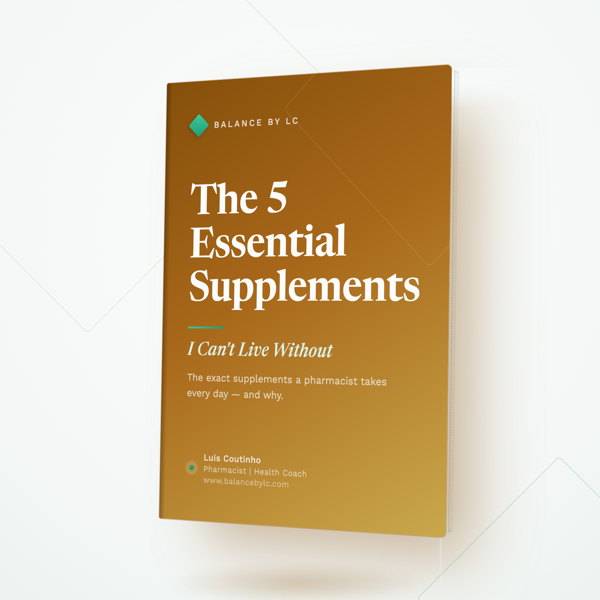
I've written a complete and free guide — "The 5 Essential Supplements I Don't Do Without" — where I elaborate on each of these supplements: mechanisms of action, forms, dosages, interactions, and how to choose a quality product.
Luis Coutinho
Pharmacist | IIN Health Coach.
Founder of Balance by LC — balancebylc.com
This article is for informational and educational purposes only. It does not replace professional pharmaceutical or medical advice.
Get scientific information about supplements every week
Subscribe and get for free: The 5 Essential Supplements I never skip.