Vitamin B12: Benefits, Doses, and How to Take It

Vitamin B12 is probably the B complex vitamin I get the most questions about. And rightly so: it's one of the few where deficiency is truly common, can go unnoticed for years, and when corrected, makes a real difference in energy, mental clarity, and nerve health. In this guide, I explain, with pharmacist's honesty, what vitamin B12 is for, where to find it, how and in what quantities to take it, whether it makes sense in a B complex or isolated, and what the truly active forms (compounds) are.
Let's get straight to the point, without beating around the bush or marketing exaggerations.
What is vitamin B12 and why is it so special
Vitamin B12, also called cobalamin, is a water-soluble vitamin essential for three vital functions: red blood cell production, proper functioning of the nervous system (maintaining the myelin sheath that protects nerves), and DNA synthesis. It works closely with folate (vitamin B9) in the so-called methylation cycle — a biochemical process that happens millions of times per second in your body.
Vitamin B12 has two peculiarities that make it unique among B vitamins. First: it's the only one the body can store for a long time (in the liver, for months or even years), which is why a deficiency can take time to show symptoms. Second: it's almost exclusively of animal origin — and this is precisely what makes it a critical point for those following vegetarian or vegan diets.
Benefits of vitamin B12
It's important to separate what's solid from what's exaggerated. The well-established benefits of vitamin B12 are primarily linked to correcting or preventing a deficiency — not to creating "superpowers" in those who already have adequate levels.
1. Energy and fighting fatigue
This is the most famous association, and it has a basis — but with an honest nuance. B12 is essential for producing red blood cells, which carry oxygen. When it's lacking, an anemia sets in, causing profound tiredness and shortness of breath. Correcting this deficiency remarkably restores energy. However, in those who already have normal levels, taking more B12 does not provide an extra "boost" of energy.
2. Nervous system and cognitive function
B12 protects nerves and participates in neurotransmitter production. A prolonged deficiency can cause tingling in the hands and feet, memory and concentration problems, and in severe and untreated cases, sometimes irreversible neurological damage. This is why early detection of a deficiency is so important.
3. Healthy blood formation
Together with folate, B12 is essential for forming normal red blood cells. Its absence causes a specific type of anemia (megaloblastic), where red blood cells become large and inefficient.
4. Mood support and homocysteine metabolism
Alongside B6 and folate, B12 helps regulate homocysteine — an amino acid whose high levels are associated with an increased risk of cardiovascular disease and cognitive decline. Lowering homocysteine with these vitamins is well demonstrated; let's be honest, however, that its translation into fewer heart attacks has not always been confirmed in large trials. The benefit is clearer in those with a real deficiency or very high homocysteine.
In summary: vitamin B12 is extraordinary at correcting a deficiency — and there, the benefits are real and sometimes transformative. It is not, however, a stimulant for those who already have normal levels.
Where to find vitamin B12 (food sources)
As mentioned, vitamin B12 is almost exclusively of animal origin. The best sources are:
-
Organ meats, especially liver (the most concentrated source of all)
-
Fish and seafood — clams, sardines, salmon, tuna
-
Meat — beef, pork, poultry
-
Eggs (especially the yolk)
-
Dairy products — milk, cheese, yogurt
Plant-based foods do not contain B12 in reliable quantities. Those following a vegetarian and, especially, vegan diet, depend on fortified foods (some plant-based drinks and cereals) or supplementation — and, in this case, supplementation is not optional, it is necessary.
How to take vitamin B12 and in what quantities
The correct dose of vitamin B12 depends greatly on the objective: maintenance, correction of a mild deficiency, or treatment of a marked deficiency. As it is a water-soluble vitamin and very safe (the body eliminates excess, and there is no established upper limit), supplement doses are often well above the recommended daily intake because oral absorption is limited.
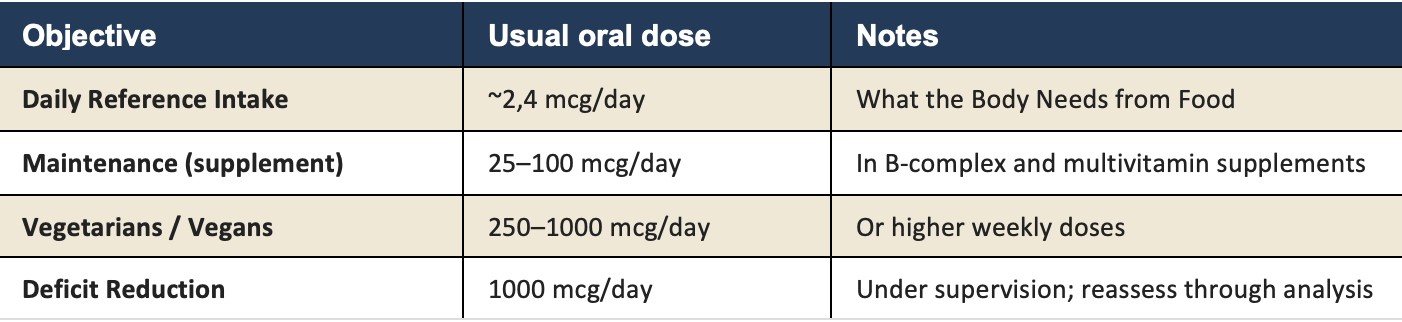
Why do supplements have such high doses (1000 mcg) compared to the reference 2.4 mcg? Because B12 absorption in the intestine depends on a protein (intrinsic factor) that easily saturates — only a small fraction of each dose is absorbed. Higher doses ensure that a sufficient amount passes, even through passive diffusion.
Timing and absorption
Take B12 preferably in the morning, as it can be slightly stimulating. You can take it with or without food. In people with malabsorption (see below), the doctor may opt for sublingual or injectable B12, which bypass the intestine.
WHO IS AT GREATER RISK OF DEFICIENCY
Pay special attention if you: follow a vegetarian/vegan diet; are over 50 (absorption decreases with age); take metformin (for diabetes) or proton pump inhibitors like omeprazole (both reduce B12 absorption); or have intestinal diseases (Crohn's, celiac disease). In these cases, it's worth checking B12 levels in blood tests.
Active compounds: methylcobalamin, cyanocobalamin, and the others
On labels, vitamin B12 appears under various names — and this is one of the most frequent doubts. Here are the four main forms, with honesty about what really matters:
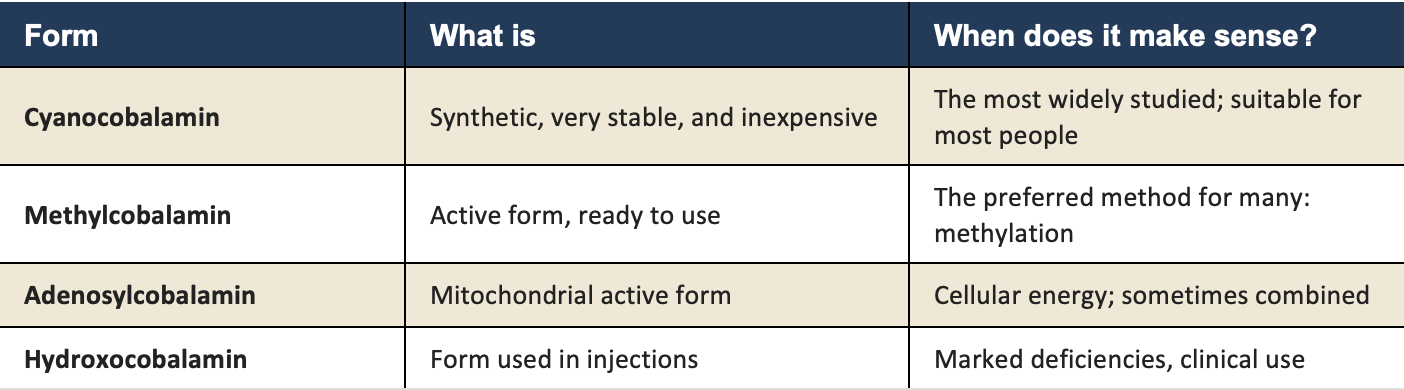
Which to choose? The balanced truth, away from marketing: in a healthy individual, the body converts cyanocobalamin into its active forms without much difficulty, and it is the form with the most studies behind it. The active forms (methylcobalamin and adenosylcobalamin) have the advantage of not requiring conversion, so they are a good choice — I generally prefer them in a quality product — but they are not an absolute necessity for everyone. Don't pay an exorbitant amount just for the word "methylated" on the label.
Vitamin B12: in a B complex or isolated?
This is the practical question that concludes the topic. The honest answer is divided into two scenarios:
- For most — B complex makes sense
B vitamins work as a team. B12 depends on folate (B9) to function in the methylation cycle, and B2 and B6 keep that cycle going. For those who want general support or are at risk of multiple deficiencies, a quality B complex is the most sensible and physiological foundation.
- Isolated — when there is a concrete reason
There are situations where isolated B12 is the right choice, almost always with professional guidance: vegetarians and vegans (clear and isolated need), confirmed B12 deficiency in blood tests, or people chronically taking metformin/PPIs. In these cases, a specific dose of B12 directly solves the problem.
An important safety warning: high doses of folic acid (B9) can "mask" a B12 deficiency in blood tests, allowing neurological damage to go unnoticed. Therefore, a suspected deficiency should never be treated with folate alone — B12 must be evaluated and corrected together.
PHARMACIST'S ADVICE
If you are over 50, vegetarian/vegan, or have been taking metformin or a stomach protector for a long time, ask to check your vitamin B12 in your next blood tests — it's inexpensive and could save you years of unexplained fatigue or tingling. And remember: supplementation corrects a deficiency, it does not replace a good diet or a medical evaluation when symptoms are present.
Conclusion
Vitamin B12 is one of those nutrients that is truly worth paying attention to — not because of trends, but because deficiency is common, silent, and perfectly correctable. Ensure good food sources, know your personal risk, check levels in tests if you belong to a risk group, and choose a quality form (active or cyanocobalamin, both work). Simple, evidence-based, and without hype — as it should be.
IMPORTANT DISCLAIMER
This article is for informational and educational purposes only. It does not replace professional medical or pharmaceutical advice, nor any diagnosis or treatment. Symptoms such as persistent fatigue, tingling, or neurological changes have many possible causes and should be evaluated by a doctor. Consult a healthcare professional before starting any supplementation.
Want to delve deeper into this topic?
I wrote a complete guide — "B Complex Vitamins: Complete Guide" — where I individually explore each of the main types of magnesium available on the market, as well as all relevant information.
→ Download— Download the Guide
Luis Coutinho
Pharmacist | IIN Health Coach.
Founder of Balance by LC — balancebylc.com
This article is for informational and educational purposes. It does not replace professional pharmaceutical or medical advice.
Get scientific information about supplements every week
Subscribe and get for free: The 5 Essential Supplements I never skip.