Magnesium and Sleep: why poor sleep may be linked to this mineral

You wake up at 3 AM unable to fall back asleep. It takes hours to fall asleep with your mind racing. You sleep enough hours, but wake up exhausted, as if you hadn't slept at all. You've tried reducing caffeine, turning off your phone earlier, improving sleep hygiene — and the problem persists.
There's a cause that is rarely considered and that may be at the root of all this: magnesium deficiency.
It's not an alternative theory. It's documented biochemistry, with multiple clinical trials published in the world's most reputable medical journals. Magnesium is involved in virtually every mechanism that regulates sleep, from melatonin production to cortisol regulation, and the activation of the GABA system that calms the nervous system.
You're not alone — and the numbers are striking
Portugal has the highest prevalence of sleep problems in Europe. A European longitudinal study that analyzed 28 countries (SHARE, Age and Ageing, 2024) revealed that 50% of Portuguese people over 50 report sleep difficulties — the highest value among all European countries studied.
In Brazil, a national study (ELSI-Brazil) with nearly 7,000 adults revealed that 58.6% suffer from some type of insomnia. And in Dubai, over 70% of residents report at least one sleep disorder, according to data released by the Dubai Health Authority.
In all these contexts, there is a common underdiagnosed factor: modern diet, chronic stress, and depleted agricultural soils create the perfect conditions for magnesium deficiency — and this deficiency has a direct and measurable impact on sleep quality.
The 5 mechanisms that explain the link
The relationship between magnesium and sleep is not a coincidence. It is well-established biochemistry, mapped in recent scientific reviews:
-
GABA system activation — magnesium is a co-factor in the synthesis of GABA, the brain's main inhibitory neurotransmitter, and enhances its calming effect.
-
NMDA antagonism — magnesium naturally blocks the receptors that keep the brain in a state of hyperexcitability and racing thoughts.
-
Cortisol regulation — magnesium deficiency keeps nocturnal cortisol levels elevated, creating the "exhausted but wired" pattern that prevents deep sleep.
-
Melatonin production — magnesium is an essential co-factor in the conversion of serotonin to melatonin, the hormone that signals to the body that it's time to sleep.
-
Circadian rhythm regulation — magnesium directly influences the genes that control the cellular biological clock.
Magnesium is not a sedative. It doesn't force you to sleep. It creates the biological conditions for the body to fall asleep naturally.
What science confirms
A randomized, double-blind, placebo-controlled clinical trial, published in Sleep Medicine X (2024), evaluated Magnesium L-threonate in adults with sleep problems and demonstrated improvements in both subjective and objective sleep quality parameters.
One of the most cited studies in the field, conducted in elderly people with primary insomnia, showed that magnesium supplementation significantly improved total sleep time, sleep efficiency, and sleep onset latency, while increasing serum melatonin levels and reducing cortisol.
As a pharmacist, it's important to be honest: the evidence is promising and clinically relevant, but the heterogeneity of studies — different forms, doses, and populations — makes a universal conclusion difficult. What is clear is that, for most people with unsatisfactory sleep associated with magnesium deficiency, supplementation is a safe, accessible, and scientifically sound intervention.
Which form is right for your sleep pattern
There isn't a single answer — it depends on how your sleep is disturbed:
-
Can't fall asleep, racing mind → Magnesium Glycinate, 30-60 minutes before bed.
-
Wake up in the middle of the night and can't go back to sleep → Citrate at dinner + Glycinate before bed.
-
Sleep enough hours but wake up exhausted → Magnesium L-Threonate, due to its unique brain bioavailability.
-
Cramps and restless legs → Magnesium Citrate at dinner.
Magnesium Glycinate is generally the best first choice: it has the lowest laxative tendency, the best gastrointestinal tolerance, and glycine — the amino acid to which magnesium is bound — has its own calming properties that enhance the effect on the nervous system.
What to expect and when
• 1 to 3 nights: easier relaxation at bedtime
• 1 to 2 weeks: improvement in ease of falling asleep
• 4 to 8 weeks: normalization of sleep patterns and nocturnal cortisol
Consistency is key. Magnesium acts by progressive accumulation — replenishing reserves, not sedating the nervous system.
Want to delve deeper into this topic?
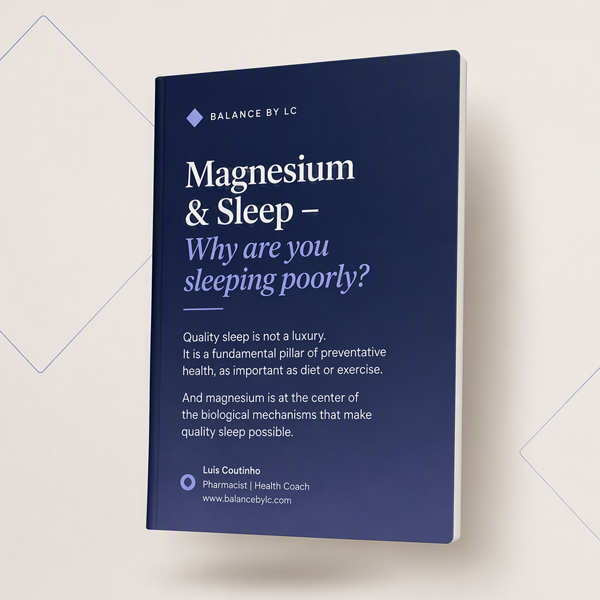
This article is based on the complete guide "Magnesium and Sleep," where I explain in detail the data on sleep in Portugal, Spain, Brazil, and Dubai, the 5 biological mechanisms, the latest clinical studies, the complete practical protocol with doses and timings, and the combinations that enhance the effect of magnesium on sleep.
Luis Coutinho
Pharmacist | IIN Health Coach.
Founder of Balance by LC — balancebylc.com
This article is for informational and educational purposes. It does not replace professional pharmaceutical or medical advice.
Get scientific information about supplements every week
Subscribe and get for free: The 5 Essential Supplements I never skip.