Blue Zones: what the regions of the world where people live longer and better teach us

Blue Zones: What do a Japanese island, a region of Sardinia, a peninsula in Costa Rica, a Californian community, and a Greek island have in common? The people living in these zones regularly reach 100 years of age, challenging the global average. Dan Buettner set out to discover why.
In 2005, researcher and author Dan Buettner published an article in National Geographic that would change the way the world thinks about longevity. With a team of demographers and researchers, he identified five regions on the planet with exceptionally high concentrations of healthy centenarians. He called them Blue Zones.
It wasn't about privileged genetics or access to advanced medical technology. It was about a set of shared habits, values, and environments that, together, created the conditions for a long and healthy life.
The 5 Blue Zones
• Okinawa, Japan — known for the world’s longest-living women; diet based on vegetables, tofu, and sweet potatoes; strong sense of purpose (ikigai)
• Sardinia, Italy — the highest concentration of male centenarians in the world; Mediterranean diet, moderate red wine, and very strong community ties
• Nicoya Peninsula, Costa Rica — one of the world's lowest rates of cardiovascular disease mortality; simple diet, natural physical activity, and strong sense of purpose (plan de vida)
• Loma Linda, California, USA — Seventh-day Adventist community; mostly vegetarian diet, no tobacco or alcohol, with strong community life
• Ikaria, Greece — the island where people forget to die; Mediterranean diet, daily nap, low stress levels, and strong social integration
The 9 Common Denominators — the Power 9
Dan Buettner identified 9 common factors across the five Blue Zones:
• Natural movement — movement is integrated into daily life: gardening, walking, cooking, not connected to the gym, although some also do that.
• Purpose — having a reason to wake up in the morning (ikigai in Japanese, plan de vida in Spanish) adds up to 7 years to life
• Downshift — daily stress-reducing rituals: nap, prayer, time to enjoy with friends
• 80% Rule — stop eating when 80% full (hara hachi bu in Okinawan)
• Plant-slant diet — beans, lentils, and soy are the staple; meat rarely and in small quantities
• Wine in moderation — 1 to 2 glasses per day, usually with meals and in a social context (except Loma Linda)
• Belong to a community — most centenarians belong to a religious or spiritual community
• Family first — caring for parents and grandparents, investing in children, stable relationships
• Right tribe — healthy habits are socially contagious; centenarians surround themselves with people who share similar values.
What the Blue Zones confirm
What fascinates me about the Blue Zones is that they confirm, with data from real populations over decades, the same principles that IIN teaches: health is not built solely with diet. It is built with purpose, relationships, natural movement, community belonging, and a diet primarily based on plants and nutritious, unprocessed, locally produced foods.
It's not about perfection. It's about consistency and context. People in the Blue Zones don't follow strict diets or go to gyms. They live in a way that makes health inevitable.
“There is no pill, supplement or diet that will recreate what the Blue Zones do naturally.” — Dan Buettner
To learn more
Dan Buettner's work is documented on the official Blue Zones website, where you will find original studies, self-assessment tools, and practical resources to apply the Power 9 principles in daily life. You can consult it here:
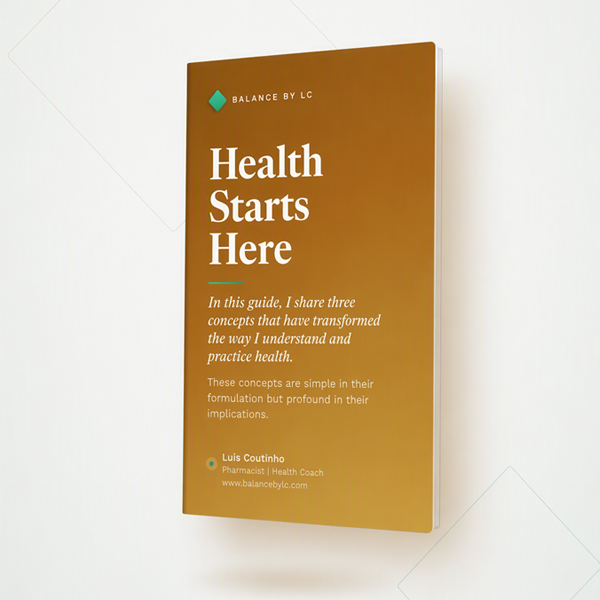
And if you want to understand how these principles articulate with Bio-Individuality, Primary Food, and Food is Medicine, download the free guide “Health Starts Here”:
My Notes
I mentioned the Blue Zones here on my blog to show that food is just one part of a whole, and that focusing only on this point is not enough to have a full and healthy life, and if possible, a long life with quality, which is what we all seek.
I know it's difficult to replicate the lifestyle that people in the Blue Zones have, as the pace is much calmer and people truly live their daily lives. Many of us in big cities end up surviving throughout the day, and that's where I want to get with this: we cannot be constantly in survival mode, and think that everything is fine just because we eat healthily and go to the gym, and then completely forget to nourish our minds.
A healthy and balanced diet, physical activity, and appropriate supplementation for your lifestyle are an important part of the process, but it's only one part. To complete the cycle, we have to look at the other parts of our lives and try to make them as nourishing as possible.
Luis Coutinho
Pharmacist | IIN Health Coach.
Founder of Balance by LC — balancebylc.com
This article is for informational and educational purposes. It is not a substitute for professional pharmaceutical or medical advice.
Get scientific information about supplements every week
Subscribe and get for free: The 5 Essential Supplements I never skip.